
Certificates of deposit
A certificate of deposit has no market price, returns its principal at maturity, and earns its return as interest. Treating it like a stock produces nonsense in every metric, so Fidolio detects it from the description and handles it apart — with a tab of its own.
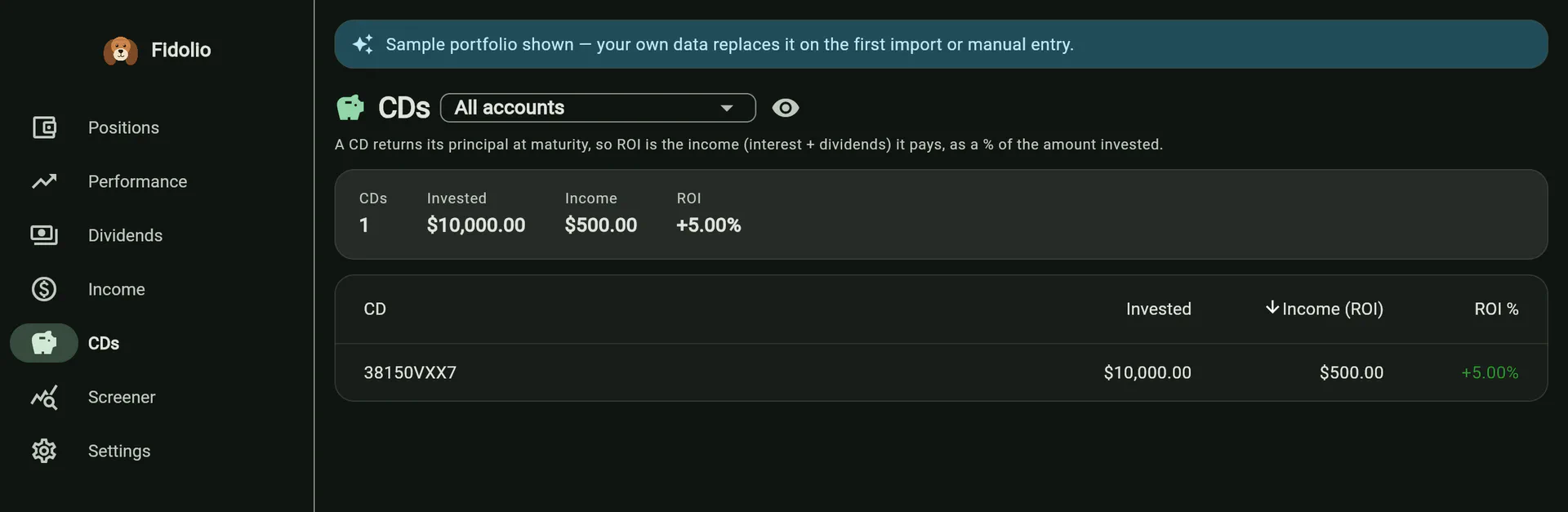
Brokerage CDs arrive in an account history looking like any other security — a CUSIP, a quantity, an amount — and every stock-shaped assumption made about them is wrong.
Detection
A holding is classified as a CD from its description: the words CD or
certificate of deposit, or a CUSIP-style symbol carrying a coupon rate and a
maturity date. From GOLDMAN SACHS BANK USA CD 5.00000% 08/15/2026 Fidolio also
parses the coupon and the maturity, which is what makes the income forecast
possible.
Renaming a holding to something more readable does not reclassify it. The custom name is used for display and search; the classification keeps reading the broker’s original text, so calling it “Goldman 5% 2027” cannot drop it out of this tab or start valuing it at a market price.
Held at principal
An open CD is valued at the amount invested, with the word principal in place of a gain/loss figure — a CD holds at par until maturity, and its return is interest, not a capital gain. That principal counts toward the portfolio total and contributes no gain or loss to it, which is what stops a large CD position from flattening the percentage return of everything around it.
It is also excluded from every price refresh. A stock-quote API has nothing to say about a CUSIP, and asking would spend a request to be told so.
ROI, not total return
For a CD, return on investment is simply the income it paid — interest plus any dividends — as a percentage of what went in. Yields are computed on gross cash spent rather than net of the maturity payout, since the payout is the principal coming home rather than a sale.
Interest is folded into the dividend total for a CD specifically, so it shows as income on the CD’s own page and in its yield, and CDs are kept out of the stock Dividends tab where they would distort every average.
Inflation is where a CD gets interesting
A CD’s principal comes back at face value — nominal dollars, unadjusted. So on the inflation view a CD is computed differently on purpose: the money invested is restated for inflation, the money back is not, and the comparison shows plainly when a headline rate trailed the price level. The sample portfolio’s 5.00% CD lands at −0.52% in real terms, which is the sort of thing a nominal ROI of +5.00% will never tell you.