
Performance & XIRR
A percentage gain says nothing about time, and an average annual return says nothing about how much was invested when. XIRR — the money-weighted internal rate of return over every dated cash flow — answers both, and Fidolio computes it per symbol and for the portfolio.
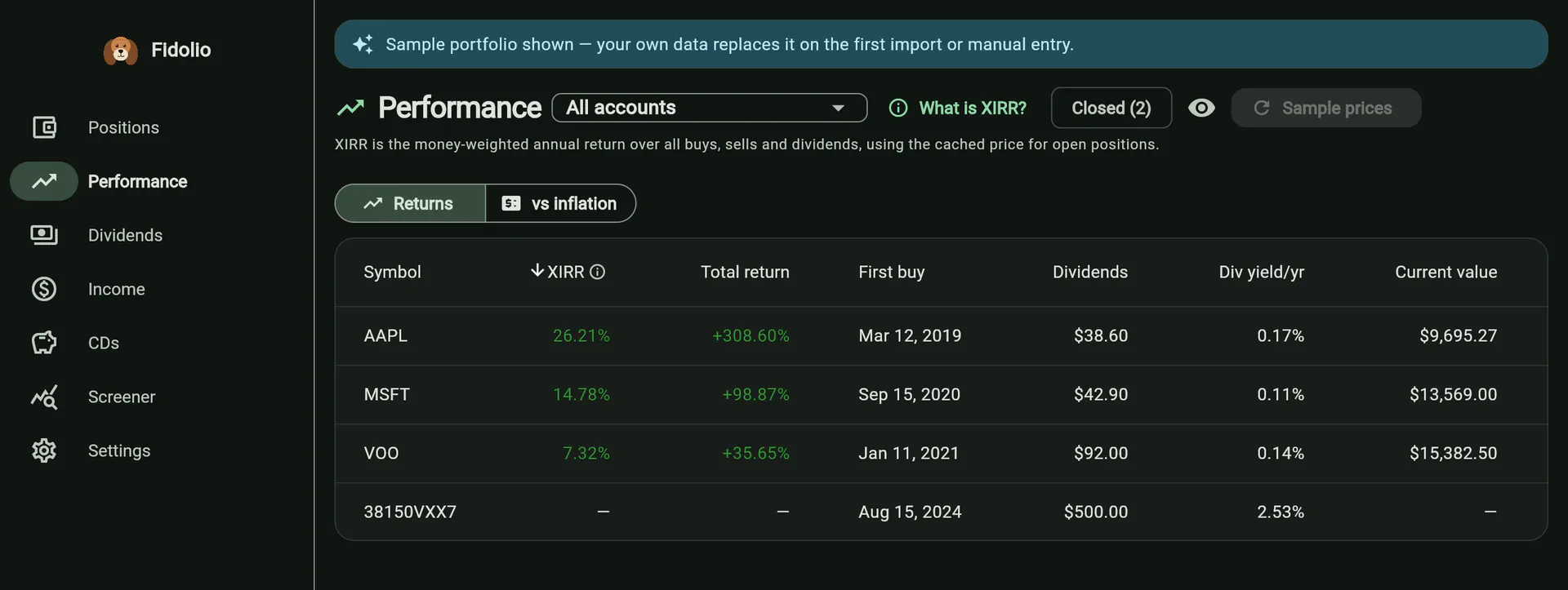
Two positions can both be “up 40%” and be nothing alike: one got there in nine months, the other over eleven years, and one of them had most of its money added last spring. The Performance tab is built around the metric that can tell them apart.
What XIRR actually is
Take every cash flow the position has ever had — each buy as money out, each sale and dividend and interest payment as money in, each standalone fee as money out — with the date it happened. Add one final inflow for what the position is worth today, as though you sold it. XIRR is the single annual rate that makes that stream come out to zero.
It is the same number a spreadsheet’s XIRR function gives you. Fidolio measures
years as days ÷ 365.25, so results differ from a spreadsheet’s 365-day
convention in the third decimal place, and the explainer in the app gives the
exact conversion.
Why it is never called CAGR
CAGR is a two-point, time-weighted growth rate: start value, end value, elapsed time. It cannot see a contribution made halfway through. XIRR is an internal rate of return over dated flows and it can. Calling one by the other’s name is not a naming quibble — it is a different claim about your money, and this app labels the figure it actually computed.
The rest of the table
- Total return % — value plus dividends plus sale proceeds, against gross cash spent.
- First buy — because a 138%/yr XIRR on a three-month holding is arithmetic, not a forecast, and the date is what makes that visible.
- Dividends and dividend yield per year, annualised honestly (see Dividends).
- Current value, from the cached quote.
Closed positions are behind a chip rather than mixed in, and the whole table narrows to one account from the header.
Interest is income, and fees are real
A cash or FDIC position and a certificate of deposit earn their return as interest, so interest counts as an inflow in XIRR and in gain/loss — not merely as a line on the Income page.
Fees come in two forms and are deliberately not counted twice. The fee and commission columns on a trade row are already baked into that row’s amount by the broker, so they already raise your cost or cut your proceeds; they are summed for display only. A standalone fee transaction — an ADR fee, foreign tax withholding, an account fee — is cash out that no trade accounts for, so it is deducted from proceeds, added to cash spent, and emitted as its own XIRR outflow.