
MongoDB
A direct wire-protocol connection: per-collection ops and latency, real index usage, and a change-stream-driven activity heat map.
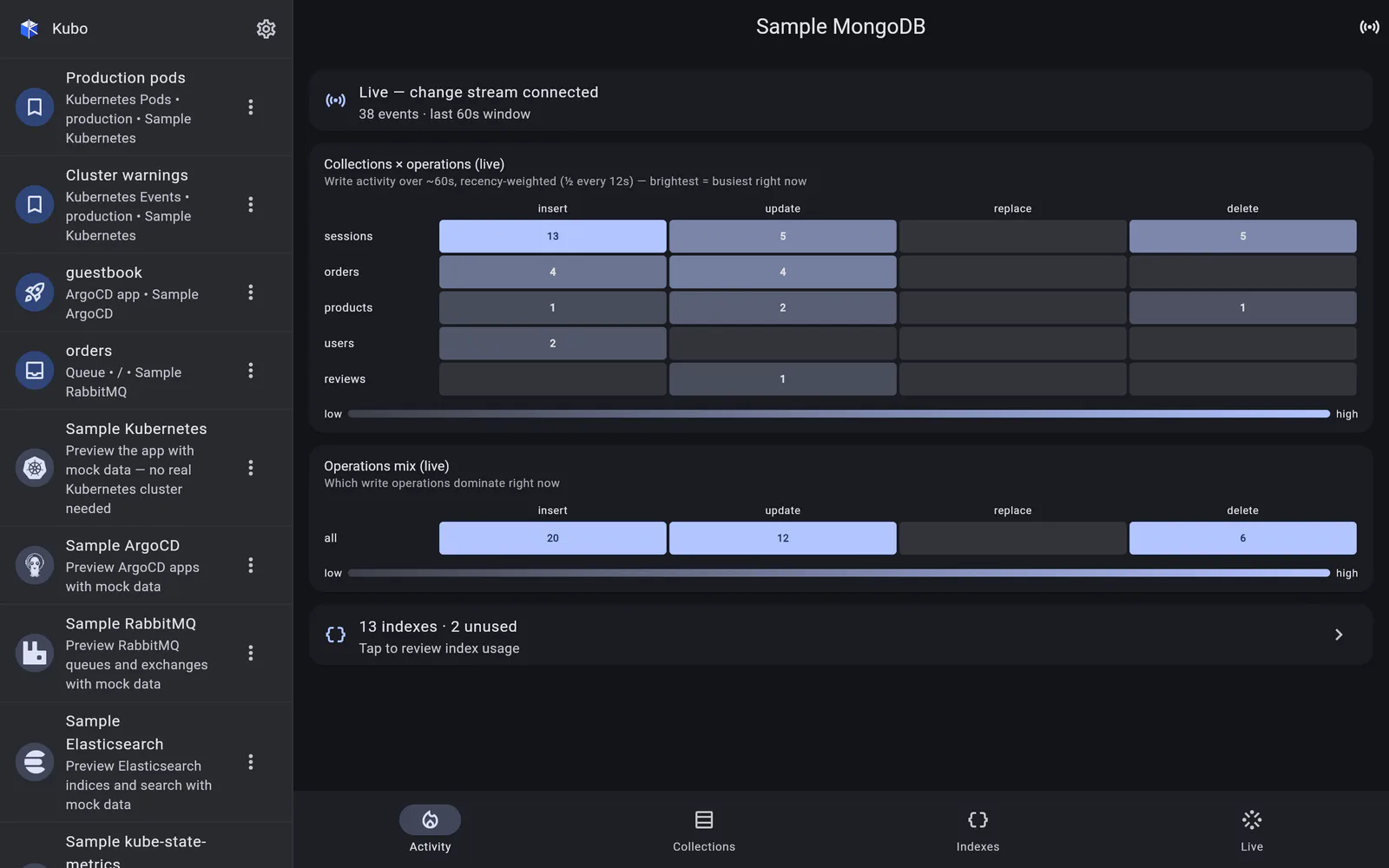
This is the live-activity counterpart to Atlas: a wire-protocol
connection straight to a mongod or mongos, rather than an admin API.
A deployment hosts many databases, so it is a top-level connection — a full
mongodb:// or mongodb+srv:// string (or host, port and an SRV toggle), scoped to a
database, with SCRAM credentials and optional TLS. It opens with four sections:
Activity · Collections · Indexes · Live.
What a driver gives you that an API cannot
- per-collection operations and latency (
$collStats); - real per-index usage (
$indexStats) — an index with zero accesses is genuinely unused, not merely unmentioned; - global counters (
serverStatus().opcounters); - a live change stream.
Counter-based statistics are cumulative, so they poll on a timer and the UI reads magnitudes; the change stream is the real-time layer on top.
Change streams are not always available
A change stream needs a replica set and the right privilege. A standalone deployment, or a user without it, is detection-gated: Kubo says the stream is unavailable and falls back to poll-only, rather than failing. And because the driver does not auto-resume a dropped change stream, the app owns the reconnect itself.
In detail
The activity heat map
Collections × operations, incremented live by the change stream, with colour tracking recency rather than totals.
Read →Collections & indexes
Per-collection ops, latency and size, and index usage read from $indexStats — so an unused index is genuinely unused.
Read →The live feed
The raw change-event stream, and what happens when a deployment cannot provide one.
Read →