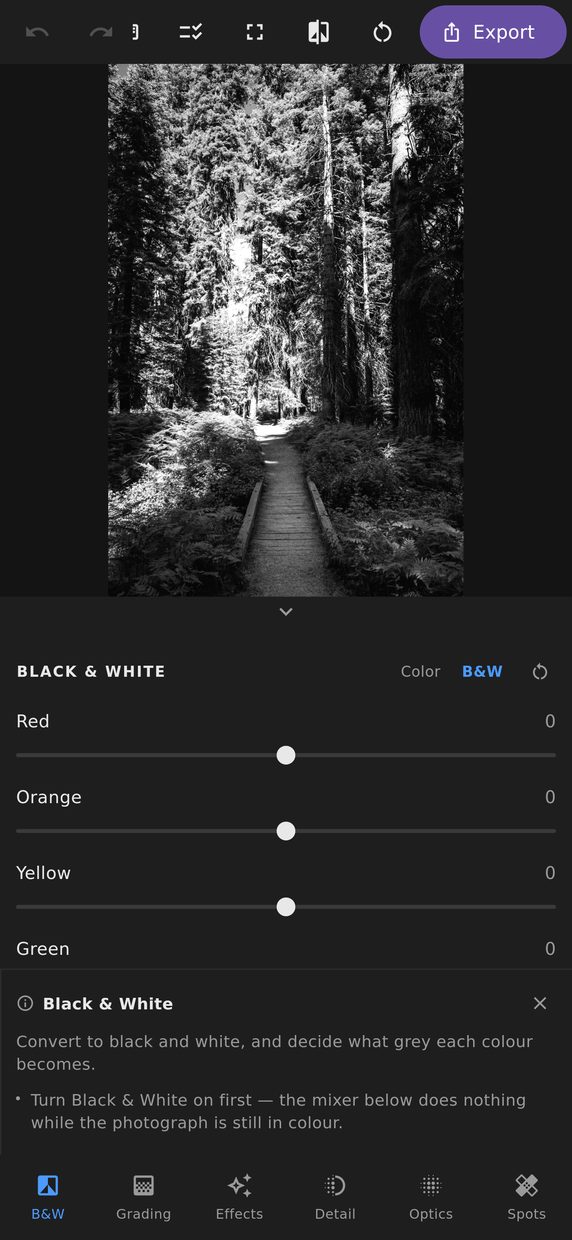
Black and white is a decision about the whole photograph rather than a filter stacked on top of one, because it changes what every other colour control means.
Why a mixer and not a checkbox
A red jumper and a green hedge can have identical luminance. Desaturate and they become the same grey — the subject stops being separable from the background and the picture falls apart.
The information the eye was using to tell them apart is exactly the colour that has just been thrown away, so there is no way to recover the separation from the tones alone. You have to say, before the colour goes, how much each colour contributes to the grey.
Pull the red band up and the green down and the jumper is bright against a dark hedge. Reverse it and the hedge glows behind a dark figure. This is the whole reason black and white is a panel.
Eight bands
Red, orange, yellow, green, aqua, blue, purple and magenta, each running −100 to +100.
The classic uses transfer directly from film. Pulling blue down darkens a sky and makes white clouds leap out — that is the red filter landscape photographers screwed onto the front of a lens for a century. Lifting orange brightens skin, which is usually flattering. Dropping orange and lifting blue does the opposite, and is how you get a hard, graphic portrait.
Neutral means neutral
Every band defaults to zero, and zero is plain luminance conversion. Switching to black and white with an untouched mixer produces exactly the luminance conversion and nothing cleverer.
A “tasteful” default in the mixer would mean nobody could get a plain conversion without first working out which sliders to undo — and you would be starting every black-and-white photograph from somebody else’s opinion rather than from your own.
Presets
The monochrome presets — a neutral conversion, a red-filter landscape, a high-contrast hard light, an infrared, a blueprint, a push process, a platinum and a duotone — are nothing more than particular settings of the mixer and the tone controls. Each is a starting point you can then take apart, because there is nothing hidden inside them.